Multi-Tenant SaaS: How to Design Data Isolation
Compare SaaS tenant isolation approaches and check queries, background jobs, storage, caches, and admin tools for accidental cross-customer access.
By RZoraTech Team, Engineering & Product · · 2 min read
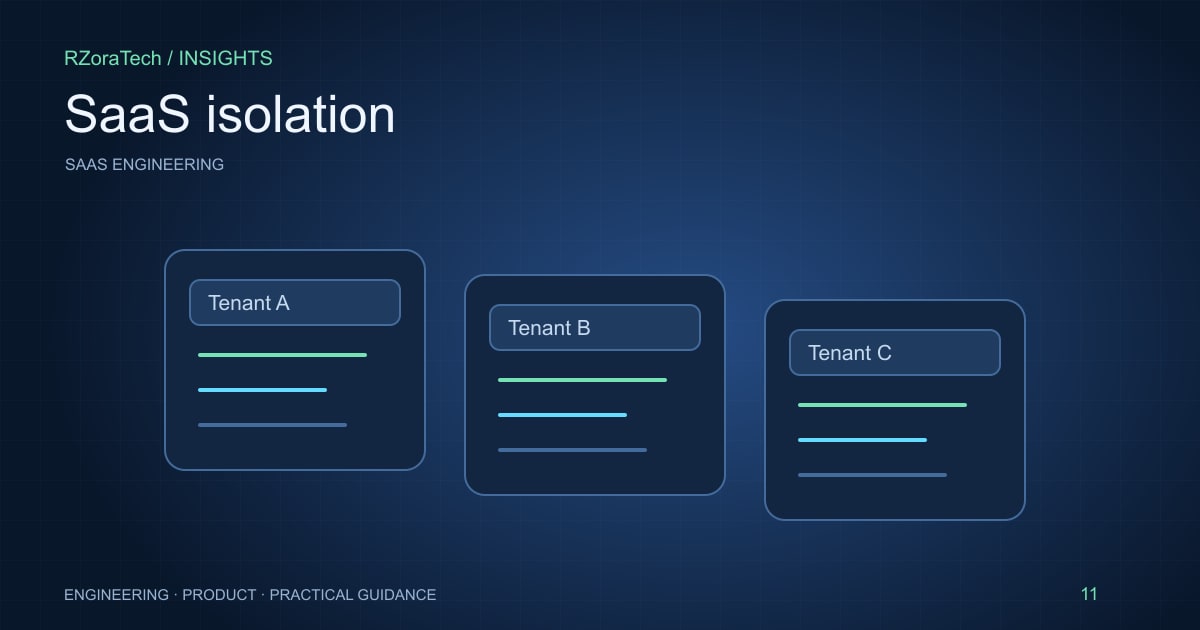
Multi-tenancy lets one product serve multiple customer organisations. The architectural challenge is sharing infrastructure without accidentally sharing private data. Choose an isolation model based on security requirements, operational capacity, and customer needs. Then verify the tenant boundary across the whole application, not just the primary database queries.
Choose an isolation model deliberately
Common models include shared tables with a tenant identifier, separate schemas, and separate databases. Shared tables can simplify operations but require reliable scoping and safeguards. Separate databases offer a stronger infrastructure boundary while increasing provisioning, migrations, monitoring, and recovery work.
Document the trade-offs before selecting a pattern. Consider customer-specific restores, data residency requirements, noisy neighbours, and support access. Isolation is not a single setting. A separate database will not prevent a shared file service or cache from returning another customer's data if application identifiers are handled incorrectly.
Carry tenant context through every workflow
Derive tenant context from authenticated membership rather than trusting a request parameter alone. Apply the context to reads, writes, exports, search indexes, scheduled jobs, and notifications. Background workers should receive enough information to validate the intended tenant without relying on an ambient global variable.
Include the tenant in cache keys and storage access rules. Review administrative tools and impersonation features explicitly. Database row-level security can provide defence in depth, but policy design, connection roles, and session state must be tested. A connection pool can complicate assumptions about request-specific database context.
Test isolation during normal maintenance
Create fixtures with similar-looking records in two tenants and test access from both directions. Check object IDs, bulk updates, exports, and deletions. Re-run those tests after introducing new integrations or optimising queries.
Plan onboarding, offboarding, backups, and restore procedures. Decide how a deleted tenant disappears from indexes, files, and queued work. Monitor unusual cross-tenant access attempts and avoid recording private content in diagnostics. The best model is one your team can operate and explain consistently as the product grows.
What to follow before development
- Document the isolation model and its operational costs.
- Derive tenant access from authenticated membership.
- Scope caches, files, workers, and support tools.
- Test cross-tenant access and customer-specific recovery.
A practical example
A shared-table SaaS correctly scopes dashboard queries but uses only the report ID as a cache key. Two customers request similarly numbered reports, exposing cached data across tenants. The team adds tenant-aware cache keys and permission checks at download, then expands isolation tests beyond database reads.
Sources and further reading
Plan your next step
Turn your priorities into a scoped engineering plan with our web app development team. For a related implementation guide, read API security.
Frequently asked questions
- Is adding tenant_id to every table enough?
- No. Queries, permissions, caches, files, workers, and integrations must all preserve the tenant boundary. Test the full workflow rather than the schema alone.