RAG vs Fine-Tuning: Choosing the Right Approach for Business AI
Compare retrieval-augmented generation and fine-tuning for business AI, including knowledge freshness, permissions, evaluation, and implementation trade-offs.
By RZoraTech Team, Engineering & Product · · 3 min read
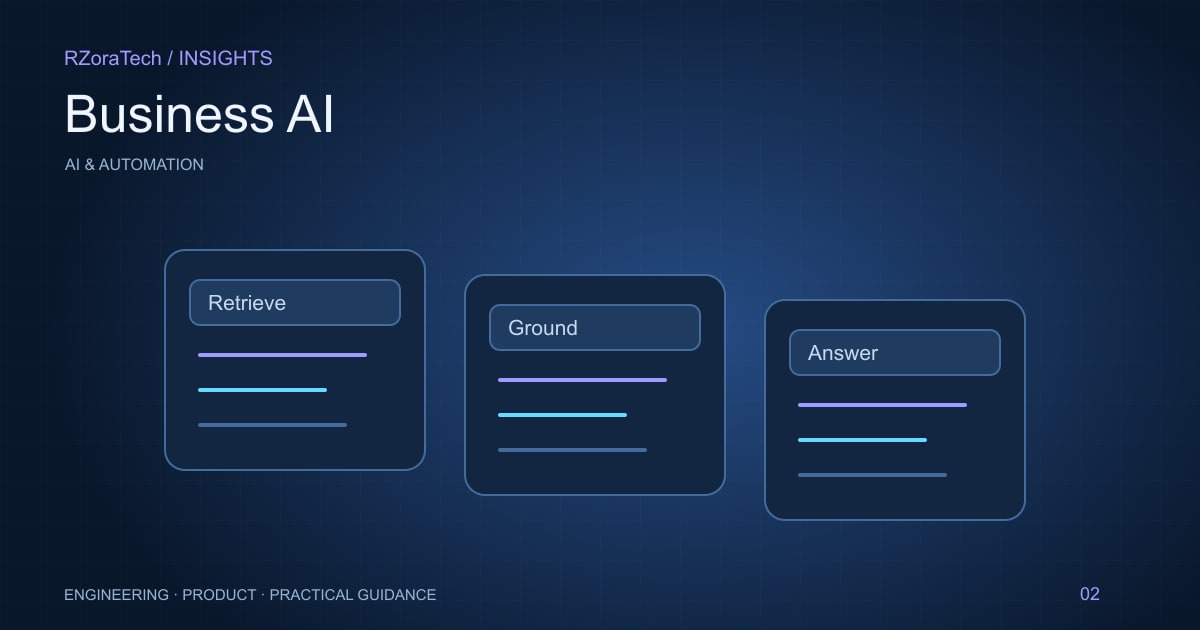
Retrieval-augmented generation, or RAG, supplies relevant information to a model when a user asks a question. Fine-tuning changes model behaviour using training examples. For a business assistant that needs current policies, product documentation, or account-specific information, controlled retrieval is often the first approach to evaluate. The two techniques can also be combined.
Separate knowledge from behaviour
Ask what is failing. If the assistant lacks an updated policy, improve the knowledge pipeline. If it repeatedly fails to follow a specialised output format despite clear instructions and examples, investigate whether fine-tuning could help. Fine-tuning is not a dependable way to keep frequently changing facts current.
Before investing in either approach, establish a baseline with a well-defined prompt, representative examples, and a supported model. Track errors by type. A retrieval failure, a permission failure, and a poor explanation need different remedies; combining them into one accuracy score hides the work that matters.
Make retrieval an authorised data product
RAG depends on document quality, indexing, chunk boundaries, and relevance. Preserve document titles, source URLs, version dates, and access rules. Apply the user's permissions before content reaches the model. Similarity search alone does not prove that a passage answers the question.
Test questions that require multiple passages, reference outdated versions, or have no answer in the corpus. Ask the assistant to identify sources and abstain when support is missing. Source citations help users verify an answer, but they must point to evidence that actually supports the claim.
Compare total operating cost
Include ingestion, storage, evaluation, and maintenance in the estimate. A retrieval system needs document updates and permission tests. A fine-tuned model needs curated examples, held-out evaluations, version management, and a plan for changing requirements. Both need privacy controls and monitoring.
Run a small experiment against the same evaluation set. Compare answer quality, supported citations, latency, and cost per successful task. Choose the simplest approach that meets the product requirement. Model demonstrations without realistic documents and user roles rarely predict production behaviour.
What to follow before development
- Classify failures as knowledge, reasoning, formatting, or access problems.
- Prepare a versioned evaluation set before changing the architecture.
- Check tenant permissions and document deletion behaviour.
- Compare retrieval quality and response quality separately.
A practical example
A SaaS help centre changes its billing policy every month. Retrieval can provide the current policy while preserving a link to the original document. Fine-tuning might later help the assistant maintain a particular response structure, but it does not replace retrieving the correct policy or checking whether a user may see it.
Sources and further reading
Plan your next step
Turn your priorities into a scoped engineering plan with our web app development team. For a related implementation guide, read AI agent readiness.
Frequently asked questions
- Does RAG eliminate hallucinations?
- No. Retrieval provides evidence, but the model can still misinterpret it. Evaluate factual support, citations, and abstention, and keep permissions outside the model.