Observability With OpenTelemetry: Logs, Metrics, and Traces
Build useful observability with OpenTelemetry, meaningful service metrics, correlated traces, safe logs, and alerts tied to customer-facing failures.
By RZoraTech Team, Engineering & Product · · 3 min read
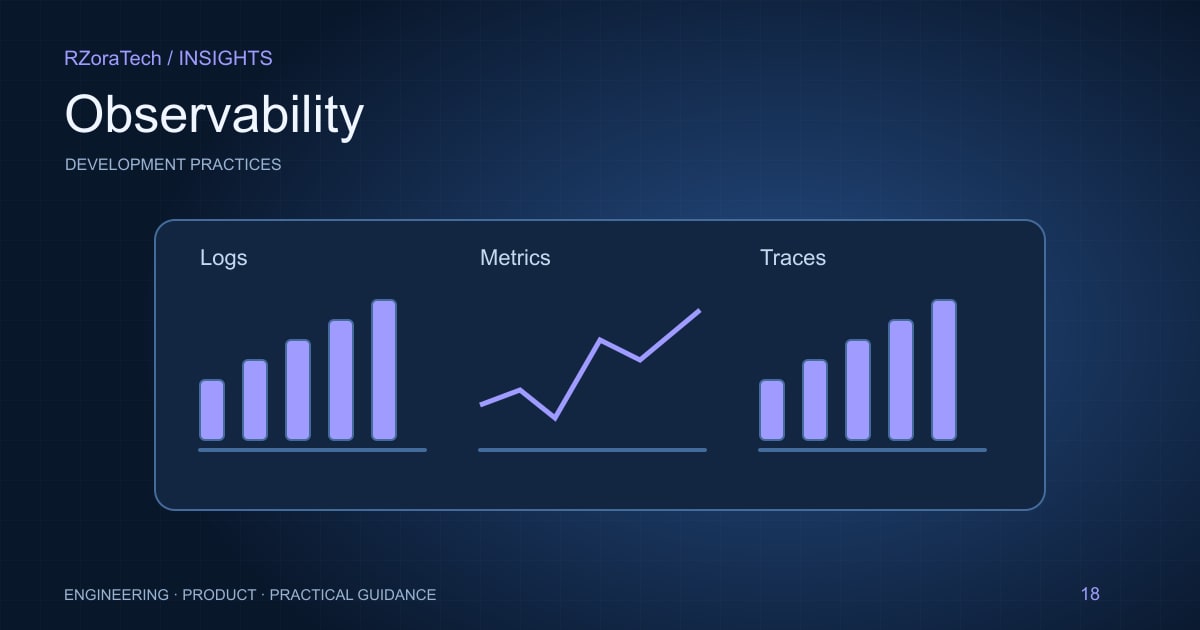
Observability helps a team understand why software behaves the way it does in production. Logs record events, metrics summarise measurements, and traces follow work across operations and services. OpenTelemetry provides a common approach to collecting and exporting telemetry. The goal is faster diagnosis and reliable customer workflows, not simply more dashboards.
Begin with the questions you need to answer
Identify critical journeys such as sign-in, checkout, report generation, and mobile sync. Ask how you would know each one is failing or becoming slow. Define relevant measures, including success rate, latency, and queue age. Infrastructure health is useful, but a healthy CPU graph does not prove users can complete a task.
Choose service-level objectives that reflect a meaningful customer experience. Use alerts when an issue needs action rather than notifying on every fluctuation. Record ownership and the first investigation steps. An alert without a response path creates noise instead of operational confidence.
Connect signals with shared context
Propagate trace context through supported service boundaries and background work. Add stable identifiers for operations where appropriate, then correlate logs with traces. Use consistent service names and environment labels so the same workflow is recognisable across dashboards.
Control attribute cardinality. Unbounded labels such as user IDs or raw URLs can make metric storage expensive and difficult to query. Keep private data, tokens, and sensitive payloads out of telemetry. Decide what to redact before instrumentation spreads across the codebase.
Balance diagnostic value and operating cost
Set sampling and retention policies based on risk and investigation needs. Verify that sampling does not systematically hide the failures you care about. Test the telemetry pipeline itself and understand what happens when an exporter or backend is unavailable. Instrumentation should not become a new point of application failure.
Use an incident review to improve signals: which question took too long to answer, which context was missing, and which alert was misleading? Remove unused dashboards and noisy events. Observability becomes valuable when the team routinely uses it to investigate and improve the product.
What to follow before development
- Map telemetry to critical customer journeys.
- Correlate request, job, and trace identifiers.
- Redact secrets and bound metric label cardinality.
- Assign alert owners, sampling policies, and retention limits.
A practical example
A report request is accepted quickly, but customers wait several minutes for completion. Request latency alone misses the problem. The team adds queue-age and end-to-end completion metrics, propagates trace context to the worker, and discovers a slow external lookup. The next alert identifies the user-facing delay rather than an unrelated server metric.
Sources and further reading
Plan your next step
Turn your priorities into a scoped engineering plan with our web app development team. For a related implementation guide, read safe billing processing.
Frequently asked questions
- Does installing OpenTelemetry create a monitoring strategy?
- No. It provides instrumentation and export capabilities. Your team still needs useful signals, dashboards, objectives, privacy rules, and an incident response process.