MVP Development: A Discovery and Scope Checklist for Founders
Plan an MVP around one validated workflow, clear acceptance criteria, user research, a risk-focused backlog, and measurable learning after launch.
By RZoraTech Team, Engineering & Product · · 3 min read
An MVP should help you learn whether a specific group of users can achieve a valuable outcome with your product. It is not simply a smaller copy of a mature competitor. Good discovery identifies the problem, the existing alternatives, the riskiest assumptions, and the minimum workflow needed to test them with real users.
Define the learning goal and target user
Describe who has the problem, when it occurs, and what they do today. Interview people about recent behaviour rather than asking whether they like an idea. Look for repeated constraints, workarounds, and consequences. A broad persona without a concrete workflow makes scope decisions harder.
Choose one learning goal for the first release. For example, can an operations manager complete a daily scheduling task faster with fewer corrections? Specify what evidence would support or weaken the hypothesis. Sign-up counts alone may not tell you whether the product delivers its intended value.
Scope a complete journey
Map the path from discovering the feature to completing the task, including onboarding, errors, and support. Prioritise capabilities required to finish that journey. Separate them from nice-to-have variations and later automation. A feature list without dependencies often hides a large implementation burden.
Use a prototype to test unclear interactions before building them. Identify technical risks such as integrations, data quality, and permissions early. Write acceptance criteria in observable terms. Even an MVP needs appropriate security and reliability for the data and actions it handles; reduced scope does not remove those responsibilities.
Plan learning and maintenance after launch
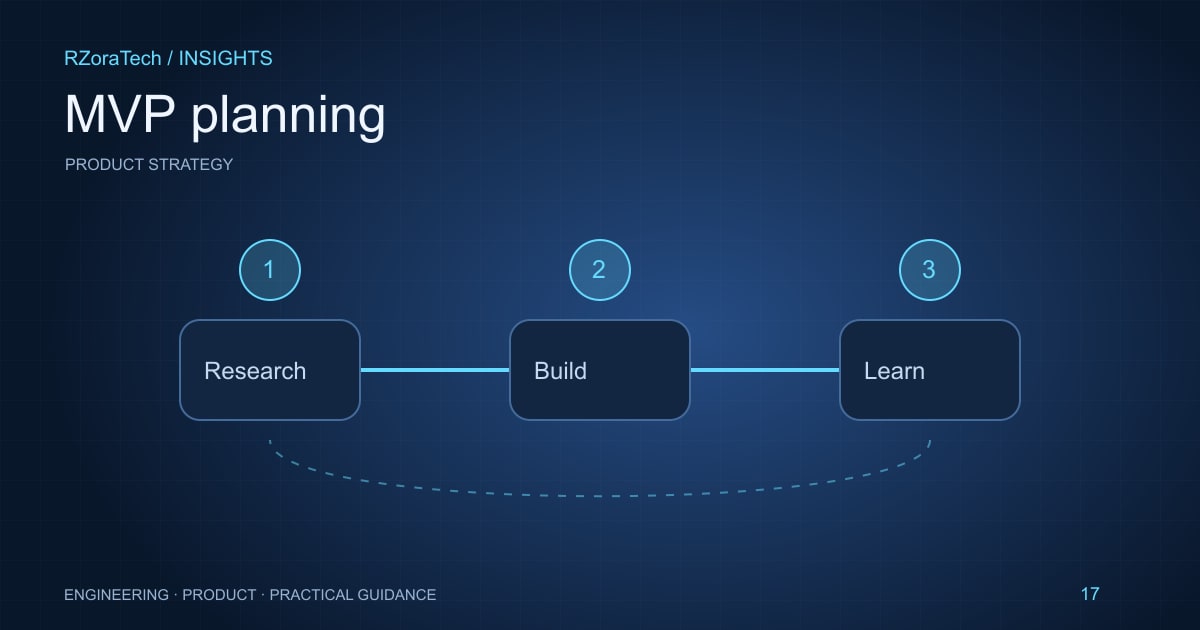
Instrument meaningful events with a clear purpose and appropriate privacy controls. Arrange user feedback and a way to investigate failures. Budget time for support, fixes, and the next decision after launch. Shipping the first version should begin a learning cycle rather than end the project.
Review scope when new evidence emerges. Record assumptions and trade-offs so stakeholders can understand why something was deferred. Avoid arbitrary feature deadlines detached from team capacity. A well-scoped MVP makes the next investment decision easier because its outcomes are interpretable.
What to follow before development
- Name the user, problem, and existing workaround.
- Define one learning goal and a complete core journey.
- Prototype uncertain interactions and technical integrations.
- Plan instrumentation, feedback, and post-launch ownership.
A practical example
A founder wants a complete procurement platform. Discovery shows the immediate pain is comparing supplier quotes. The MVP supports uploading quotes, reviewing comparable fields, and recording a decision. Purchase-order automation is deferred. The team measures completed comparisons and correction effort before expanding into the wider procurement workflow.
Sources and further reading
Plan your next step
Validate the workflow before committing to implementation with our UX/UI design team. For a related implementation guide, read architecture for growing products.
Frequently asked questions
- Does an MVP mean sacrificing security and reliability?
- No. Limit the scope of features, but protect the data and actions that remain. Essential permissions, error handling, and operational ownership still belong in the first release.